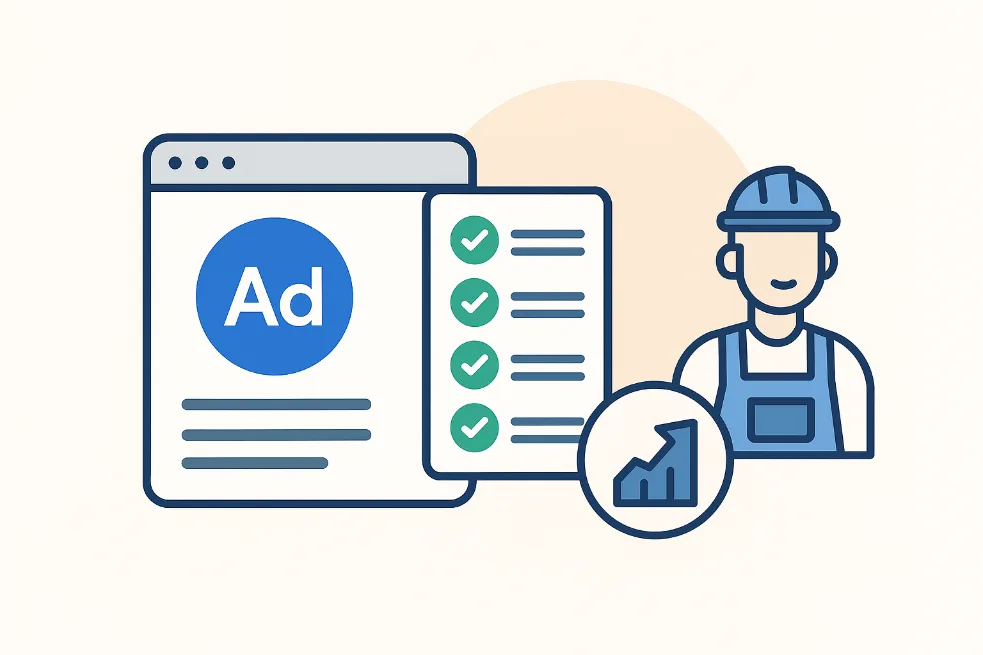
Introduction: why this guide will really help you
You offer a service and want to win new enquiries predictably via Google Ads – but don't know exactly what really matters? Then you've come to the right place. In this guide, I show you step by step how to use Google Ads specifically for your service: from keyword strategy and suitable landing pages to ongoing optimisation.
The goal: more qualified leads, lower costs per enquiry and a measurable contribution to your revenue growth.
If you're looking for a suitable Google Ads provider, you'll also find a practical checklist for choosing one at the end – including tips on what to look out for with freelancers and agencies.
Would you rather hand the campaigns over? I describe how ongoing Google Ads management works with me on a separate page.
Why Google Ads works particularly well for service businesses
Anyone looking for a service usually has a specific need – and often wants a solution straight away. This is exactly where the great strength of Google Ads lies: you become visible at the very moment someone is actively searching for what you offer.
Unlike social media or classic banner advertising, you don't reach your target audience “in passing” but at the moment of decision. This reduces wasted spend, increases the likelihood of closing and makes your success measurable.
Many searches – for example “house clearance Berlin”, “personal coach Hamburg” or “beauty salon with Hydrafacial” – show a strong intent to buy or book. With the right keywords, ads and landing pages, you can capture this demand in a targeted way. Google Ads is therefore one of the most effective ways to win new customers predictably and increase your visibility at the most relevant moment.
Google Ads doesn't only work for large companies but also for solo self-employed people and small businesses. If you'd like to know more, here is my article on Google Ads for small businesses. For medium-sized businesses there is a separate page: Google Ads for SMEs.
The 6 building blocks of a strong Google Ads strategy for service businesses
1. The right keyword strategy: transactional rather than purely informational
Many service businesses make the mistake of relying on keywords that are too general or informational. Instead of “house clearance tips”, you should bid on “house clearance Berlin” or “flat clearance Berlin” – that is, on search terms with a clear intent to act.
Structure your ad groups so that each one represents a clear service area and a specific intent. Preferably use phrase match keywords to combine reach and control.
You can use informational keywords later for SEO or content marketing – in paid search, they often have no place at the start.

2. Regional targeting: set priorities, start locally
Especially for local services: presence in your immediate surroundings is more important than reach across the whole region. So start with a narrow geographic focus – for example with radius targeting or specific postcodes. This is particularly crucial for industries such as the trades – here is my article on Google Ads for tradespeople.
A proven tactic is to split campaigns into priority A campaigns (e.g. 10 km around your location) and priority B campaigns (a wider area). This lets you allocate your budget to where the probability of closing is highest – and scale in a targeted way when successful.
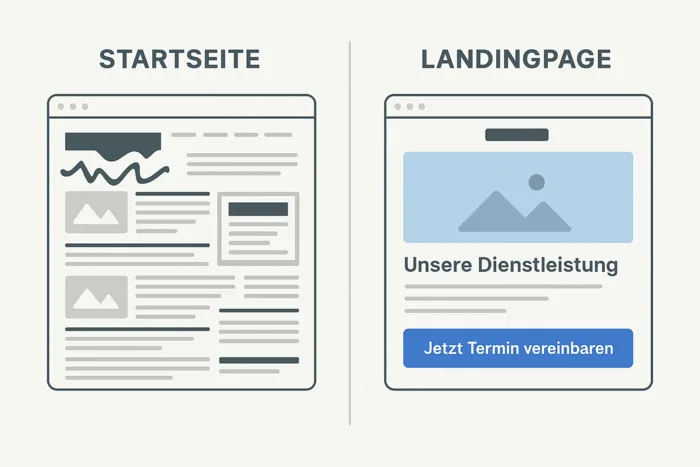
3. Tailored landing pages: don't just link to the home page
A common mistake in many accounts: the ads lead directly to the general home page. That's wasted potential.
For maximum relevance, you should create a separate landing page for each service and region. These pages should:
- clearly communicate the concrete benefit of your service
- perform well on mobile
- contain trust-building elements such as customer reviews or seals
- and offer a clearly visible call to action (e.g. “Book an appointment now”)
If you offer different service packages, a separate landing page is worthwhile for each of them too – that way you can respond more precisely to your customers' needs and achieve better conversion rates.
4. Clean tracking and consent
Without tracking, you can't make well-founded decisions. So set up clean conversion goals – for example for:
- Contact forms
- Calls
- Appointment bookings
Important: make sure the measurement is GDPR-compliant, e.g. via Consent Mode V2. And make sure your goals are set up consistently in Google Ads and Google Analytics. Only then can you really optimise your campaigns based on data and use your budget efficiently.
5. A bid strategy with a plan
At the start, a rather conservative approach is recommended – for example with manual CPC or the “Maximise clicks” option combined with a fixed maximum bid. This avoids unnecessary costs while there is little or no conversion data yet. Once enough data has been gathered, you can switch to smart strategies such as “Maximise conversions” with a target CPA.
Make sure you optimise regularly:
-
Is your target CPA realistic in relation to your actual CPA?
-
Do you have enough conversion data to use automated strategies sensibly?
-
Are you testing different bid strategies against each other, e.g. with an A/B test?
These questions help you decide on a sound basis whether your current strategy is working – or whether a change is worthwhile.
6. Continuous optimisation instead of “set up once”
Google Ads is not a “set it up once and let it run” channel. Successful campaigns are continuously optimised – with clear routines and measurable changes.
Plan regular cycles in which you:
- test new ad variants (A/B tests)
- add ad extensions
- revise landing pages
- fine-tune bids
- analyse audiences and times
Document all changes and review how your KPIs develop over time. That way, you ensure your campaigns don't just work in the short term – but keep getting better.
What makes good Google Ads for service businesses
Successful Google Ads campaigns for service businesses don't follow the principle of chance. They are based on a clear strategy, a well-thought-out structure and consistent optimisation. What distinguishes such campaigns?
They are aimed precisely at a defined target audience, take search intent into account and offer a matching ad with the right landing page for every need. Budget isn't burned at random but invested specifically in keywords that deliver real business value.
Good campaigns don't just measure clicks – they measure what counts: enquiries, bookings, contributions to revenue. And they are continuously improved. Not every keyword stays relevant, and not every ad works equally well. Successful service businesses keep developing their campaigns, trim unnecessary areas and invest where it pays off.
In practice: how to set up a first campaign
The theory is clear – but what does the first step look like in practice? Here is a proven roadmap for setting up your first Google Ads campaign for services properly:
- 1.
Set up the account and tracking properly
Before you run ads, you need a technically clean foundation. Set up your Google Ads account correctly and integrate conversion tracking via Google Tag Manager – e.g. for form submissions, calls or appointment bookings. Be sure to also use Consent Mode V2 to measure in a GDPR-compliant way.
- 2.
Keyword research: identify relevant searches
Before you plan campaigns and ad groups, you should find out what your potential customers are actually searching for. Focus on transactional keywords with a clear intent to act – not “How much does a house clearance cost?” but rather “house clearance Berlin costs” or “hire a house clearance company”.
Use tools such as the Google Keyword Planner or Sistrix – and don't forget to create an exclusion list of irrelevant terms if necessary (e.g. “job”, “DIY”, “free”) to avoid wasted spend.
- 2.
Structure services and search intentions
I recommend creating a separate search campaign for each of your main services. This ensures a clean structure and gives you more control over budget, targeting and performance for each offer.
Within the campaign, you should then create one ad group per search intent – so don't lump everything together under “house clearance Berlin”, but differentiate in a targeted way.
Example:
“house clearance Berlin costs” shows a different intent from “hire house clearance Berlin”.
So these should also be two separate ad groups – each with matching ads and, if necessary, their own landing pages.
That way, you reach potential customers with exactly the message that suits their situation – and significantly increase your relevance and conversion rate.
- 3.
Define location targeting
For local services in particular, geographic targeting is crucial.
Start with a clearly defined service area – e.g. with radius targeting (5–15 km) or by postcode. If it makes sense, divide it into:
Priority A zone: close to your business premises, high likelihood of closing
Priority B zone: wider surroundings, lower priority
That way, you steer your budget to where enquiries are most likely.
- 4.
Define a daily budget
To start with, €10–30 per day and campaign is often enough – depending on region, industry and competition. In the initial phase, the focus is on gathering first data and validating the structure.
- 5.
Write ad copy
Now it's time for the ads. The goal: short, concrete, persuasive.
Use your headlines to address either a problem, a benefit or an advantage. A clear call to action is important – for example:
“House clearance Berlin – get a free quote now”
Run at least 3 variants per ad group – so that you can compare and optimise later.
- 6.
Launch the campaign – and monitor it closely
Let the campaign run for a week first. Then check:
- Which search terms were triggered?
- Which search terms achieved conversions?
- What else can I optimise?
- Which search terms should I exclude?
Based on this data, you keep optimising keywords, bids, ads and landing pages in a targeted way.
Typical mistakes that cost budget
Many service businesses burn budget unnecessarily – not because their offer is bad, but because the campaigns were not implemented properly. Here are the most common pitfalls:
- 1.
Home page instead of landing page:
Sending ads to the general website or even the home page risks high bounce rates. Visitors have to find their own way – and often leave before they even understand what you offer.
- 2.
Keyword sets that are too broad:
Keywords such as “lawyer” or “coach” without a regional or thematic restriction are expensive and imprecise. Without negative keywords, you'll also be shown for irrelevant searches – for apprenticeships, free tips or job offers, for example.
- 3.
Display Network accidentally active:
The Display Network is generally not suitable for lead generation for service businesses. If it's activated by accident, a large part of the budget flows into clicks of little relevance.
- 4.
Missing extensions:
Call extensions, location extensions or sitelinks don't just increase visibility – they also improve the click-through rate. Doing without them means wasting potential.
- 5.
Smart bid strategies too early:
Automated bid strategies such as target CPA or ROAS need data. Using them too early – without sufficient conversion history – risks inefficient spending.
- 6.
No clear conversion definition:
What exactly counts as success? Without a clear definition and tracking, there's no basis for optimisation – and you're in the dark when it comes to budget decisions.
Example: what a good Google Ads structure for service businesses could look like
A sensible campaign structure is crucial for using your budget efficiently and keeping control over your ads. As a service business in particular, you should clearly separate which service is advertised in which context. A possible structure:
- Ad group “[Main service] [City]”
e.g. “removal company Berlin” or “coaching Munich” - Ad group “Consulting [topic]”
Ideal for coaches, therapists, lawyers or doctors, for whom booking an appointment is the main goal - Ad group “[Main service] costs”
Each ad group should lead to a matching landing page – with a clear headline, trust elements and a call to action. You should also add extensions such as location, phone number and sitelinks.
A solid negative list rounds off the structure – for example with terms such as “free”, “job”, “training”, “PDF”, “DIY” or with competitor names if you want to avoid them.
Budget planning: start realistically, then scale
Many people think Google Ads is automatically expensive – because a click often costs several euros. But what matters is not the click price itself but the price per customer won. And that can be very low – despite high click costs – if the campaign is set up well.
Sometimes it's even worth paying a little more per click – especially in highly competitive industries such as Google Ads for removal companies. Because if certain keywords are particularly competitive, it usually indicates that they work profitably for many competitors. More expensive clicks don't automatically mean wasted money – but often higher chances of closing.
For many local service businesses, a daily budget of between 10 and 30 euros is enough to start with. That's sufficient to gather initial data and achieve measurable conversions.
It's important that you regularly check:
- Which search terms were shown?
- What is your share of possible impressions?
- What does an enquiry cost you?
- How many of these enquiries become real customers?
- What is the average order value?
- If you track cleanly, you can increase budgets step by step – without the risk of burning money unnecessarily.
How to check the quality of your ongoing work
You already have campaigns running – but how well do they really work? A strong Google Ads strategy shows not only in the setup but above all in consistent further development.
These questions will help you assess it:
- Is there separation by search intent?
Are transactional keywords clearly separated from informational ones? Is there a separate ad group and landing page for each topic? - Are regular A/B tests running?
Do you test ad variants, extensions or landing pages to achieve better results in a targeted way? - Is the exclusion list maintained?
Are irrelevant or expensive search terms regularly weeded out? - Is there a geographic and time-based evaluation?
Do you use reports on regions, times of day or devices to adjust bids? - Are goals, budget and KPIs documented transparently?
Are there regular reports that show not only clicks but real results such as enquiries, closing rates or contributions to revenue?
If you have to answer “no” to several of these questions, there is probably still a lot of untapped potential in your campaign.
Where can I find a good freelancer or a good agency?
If you don't want to manage Google Ads yourself, the question is: a freelancer, a traditional agency or an owner-led agency? Each option has pros and cons – what matters is which suits your business, your budget and the scope of your project better.
Freelancer:
Ideal if you're looking for direct contact, quick responses and tailored management. Many freelancers work very hands-on, understand your business in detail and implement campaigns themselves – without lengthy coordination.
Agency:
Makes sense if you're more broadly positioned, advertise several services or locations or need additional channels such as Meta Ads or SEO. Agencies bring more resources – but communication and processes are often less individual.
Owner-led agency:
The third option lies in between: an agency in which the owner manages the accounts personally. You have direct contact as with a freelancer and speak to the person working in your account. For related services such as social ads or web design, there are established partners. That's how I work with Conversion Go. You'll find more on the Google Ads agency pages for Hamburg, Berlin and Munich.
Checklist for choosing a suitable Google Ads provider
Want to outsource Google Ads but don't know how to recognise a good provider? This checklist will help you assess them – whether freelancer or agency:
- Industry knowledge: has the provider already worked with similar businesses?
- Transparency: do you have full access to the Google Ads account – or only to a reporting tool?
- Strategic approach: is there a clear plan – from defining goals to optimisation?
- Operational contact: do you speak directly with the person who manages the campaign?
- Measurability: is it clearly explained how success is measured and how reports are structured?
- Willingness to test and learn: are hypotheses formulated and checked with A/B tests?
- Resource fit: does the collaboration suit your business in terms of time, money and organisation?
Avoid providers who make blanket promises – e.g. “100 leads a month guaranteed”. Reputable providers ask questions, analyse your status quo and develop strategies based on it.
Conclusion: how to get the maximum effect from Google Ads
If you really want to use Google Ads successfully as a service business, you need more than a few clicks on your website. What matters is a clear goal, a structured campaign setup, persuasive landing pages and consistent optimisation.
Focus on your core area first, work with specific searches instead of general terms – and only invest where you can measure real results.
If you're already running ads, an honest look at the quality of your campaign is worthwhile. If you want to start from scratch, now is the perfect time for a professional setup – so that you don't just spend money but win new customers predictably.
Frequently asked questions about Google Ads for service businesses
How do service businesses use Google Ads profitably?
By bidding on search terms with clear intent to act, starting with a narrow service area and sending every ad to a matching landing page instead of the home page. Add to that clean conversion tracking for forms, calls and appointment bookings. What matters is not the click price but the price per customer won, and that falls through ongoing optimisation.
How do I recognise a competent Google Ads agency?
You have full access to the Google Ads account and not just to a reporting tool. You speak directly with the person who manages your campaigns. There is a clear plan from defining goals to optimisation, and success is measured by enquiries rather than just clicks. Be wary of blanket promises such as “100 leads a month guaranteed”. The complete checklist is further up in the article.
Which provider can manage my campaigns?
The options are freelancers, traditional agencies and owner-led agencies. A freelancer is a good fit if you're looking for direct contact and quick responses. A traditional agency makes sense if you advertise several services or locations or need additional channels. In an owner-led agency, the owner manages your account personally. What that looks like with me is described on the Google Ads management page.
How much budget does a service business need?
For many local service businesses, a daily budget of between 10 and 30 euros per campaign is enough to start with. That's sufficient to gather initial data and achieve measurable conversions. If you track cleanly, you can then increase the budget step by step. How to calculate your monthly budget is explained in the article Google Ads costs.
About me
I'm Viktor Wagner – a certified Google Ads freelancer specialising in targeted lead generation via Google Ads. My focus is on clear strategies, clean tracking and transparent communication.
I prefer to work with service businesses, start-ups and small to medium-sized businesses and help them generate more qualified enquiries, with measurable results instead of vague promises. I value efficient implementation and personal support. Further reading: Google Ads for local businesses, the Google Ads audit for existing accounts and conversion tracking as the basis for every analysis.

Want to know how good your current setup is, or whether Google Ads is worthwhile for your business at all?
Then request a free potential analysis now. You'll get a clear assessment, concrete recommendations and, if you wish, a tailored quote.
Get in touch